
How to Relocate Your Office in New Zealand A Step-by-Step Guide
Relocating your office in New Zealand? Our step-by-step guide covers every aspect of the move. Allied's commercial moving team is here to help.
Posted on June 1, 2026 |
Introduction
An office relocation is one of the more complex projects a business will take on. Unlike a residential move, you are coordinating around staff, clients, technology infrastructure, lease obligations, and operational continuity all at the same time. Done well, a business relocation is an opportunity to set your team up in a space that works better for how you operate. Done poorly, it creates disruption that takes weeks to recover from.
This guide covers the full office relocation process from initial planning through to settling into your new premises, with practical guidance for businesses of all sizes.
Allied New Zealand’s Six Step Guide
Step 1: Start Planning Earlier Than You Think You Need To
Most office relocations require more lead time than businesses anticipate. Depending on the size of your operation, a realistic planning window is anywhere from three months for a smaller office to twelve months or more for a larger multi-department move. The earlier you begin, the more control you retain over timing, costs, and logistics.
At the outset, assign a relocation project manager. This does not need to be a dedicated role, but someone needs to own the process and be the single point of contact for decisions. Without clear ownership, office moves tend to stall on small decisions and create confusion among staff.
Key Questions To Answer At The Planning Stage
What is your target move date, and does it align with your lease end or new lease commencement?
What is the floor plan of the new premises, and how will your team be laid out?
Which items are coming from the current office, and what will be disposed of, donated, or replaced?
What are your IT and infrastructure requirements, and who is coordinating the technology side of the move?
How will you communicate the move to staff, and what support do they need?
Step 2: Notify The Right People
An office move affects more parties than most businesses initially account for. Getting notifications out early avoids administrative headaches closer to the move date.
Internal Communications
Staff should be informed of the move as early as possible, with regular updates as the date approaches. This includes confirming their new workstation arrangements, any changes to parking or commute options, and the timeline for the actual moving day. People manage change better when they feel informed and involved.
External Notifications
Clients and suppliers: update your contact details and business address across all correspondence and systems
Companies Office: update your registered address on the New Zealand Companies Register
IRD: notify Inland Revenue of your new business address
Banks and financial institutions: update business account details
Insurance providers: confirm your business insurance covers the new premises from the date of occupation
Any professional registrations or industry bodies that hold your address
Step 3: Manage Your IT And Infrastructure Carefully
Technology is almost always the most business-critical element of an office relocation, and the one most likely to cause extended downtime if not managed properly. Your IT setup needs its own workstream within the broader relocation plan.
What To Plan For
Confirm internet and phone line availability and installation lead times at the new premises. Providers in New Zealand can have installation windows of several weeks, so this needs to be booked well in advance
Arrange for server rooms or networking infrastructure to be set up at the new location before the move, where possible
Label all cables, hardware, and peripherals clearly before disconnection so reconnection at the other end is straightforward
Back up all critical data before the move begins
Confirm who is responsible for disconnecting, transporting, and reconnecting IT equipment. This is typically handled by your IT provider or an internal IT team, separate from the physical moving team
Allied's commercial moving team works closely with business IT coordinators to ensure equipment is handled correctly in transit, with appropriate protection for servers, monitors, and sensitive hardware.
Step 4: Arrange Disposal, Storage, And Fit-Out
Disposing Of What You Are Not Taking
An office move is a practical opportunity to clear out what is no longer needed. Outdated equipment, excess furniture, and archived paper records that have passed their retention period can be disposed of responsibly before the move rather than transported unnecessarily. Many items can be donated to community organisations or recycled through appropriate channels.
Storage For Items You Are Not Ready To Move
In some cases, businesses relocate to a new premises before a full fit-out is complete, or need to reduce the volume of furniture temporarily while the new space is being configured. Allied's business storage solutions provide a secure option for holding furniture, equipment, or archived materials during the transition period.
Fit-out And New Furniture
If the new premises requires fit-out work, coordinate this with your move date carefully. Ideally, all building work is completed before your team arrives. If there is overlap, ensure the areas being worked on are clearly separated from the areas being occupied, and that your staff have safe access to their workspaces from day one.
Step 5: The Move Itself
With planning in place, the physical move should be the most straightforward part of the process. A few things make a meaningful difference on the day.
Confirm the logistics in detail with your removalist in the week before the move. This includes truck arrival times, access arrangements for both buildings, lift bookings if required, and any restrictions on moving hours that apply to either premises
Have a floor plan ready for the new space and ensure the removalist team has a copy. Label furniture and boxes with their destination room or workstation so items end up in the right place without requiring staff to direct every piece
Assign staff roles on moving day. Someone should be present at the old premises and someone at the new one, both able to answer questions and make decisions
Do a full walkthrough of the old premises at the end of the day to confirm nothing has been left behind and the space has been left in the condition required by your lease
Step 6: Getting The Team Settled
The move itself is complete when the last box is delivered. Getting your team fully operational takes a little longer, and it’s worth planning for a settling-in period rather than expecting full productivity from day one.
Set up a clear point of contact for staff to report issues in the new space, whether that is a facilities manager, office manager, or designated team lead
Communicate any changes to building access, security codes, or parking arrangements clearly before people arrive on their first day
Check that all workstations are functional, including phones, computers, and any shared equipment
Walk the new premises with health and safety in mind. Emergency exits, first aid kits, and evacuation procedures should be confirmed before the team begins working from the new location
Working With A Commercial Removalist
The difference between a well-managed office relocation and a disruptive one often comes down to the experience of the removalist handling it. Commercial moves are meaningfully different from residential ones. The equipment is heavier, the logistics are more complex, and the cost of downtime is real.
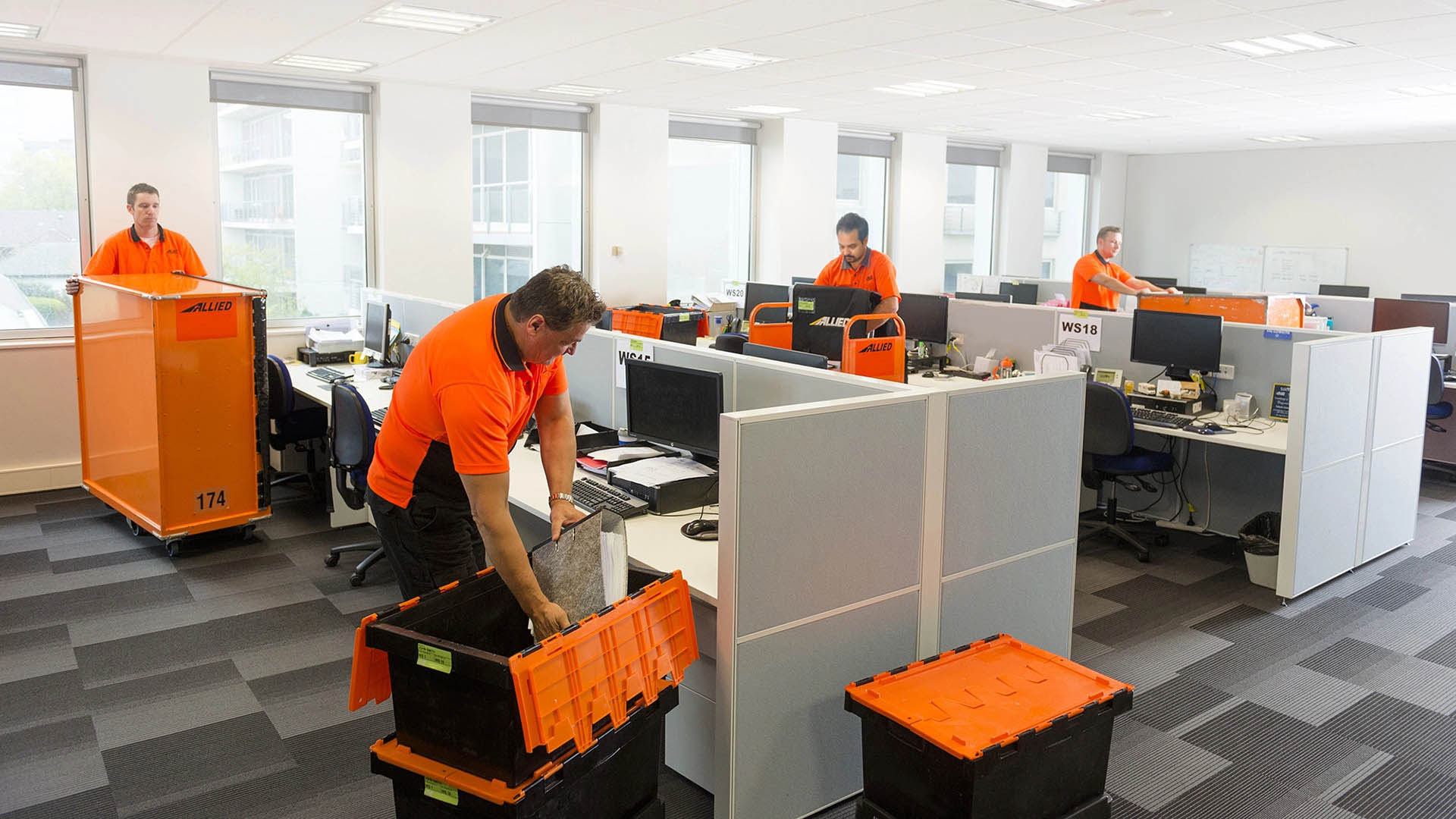
Allied has extensive experience managing business relocations across New Zealand, from small professional offices to large multi-floor operations. Our commercial moving team provides a dedicated consultant to work through the planning process with you, coordinate every stage of the physical move, and ensure your team is operational in the new premises as quickly as possible.
To discuss your office relocation and receive an obligation-free quote, get in touch with the Allied team.
Ready to start your journey with us?
Get your free quote today